B+S
Location |
Client |
Service |
Category |
Completion |
Description
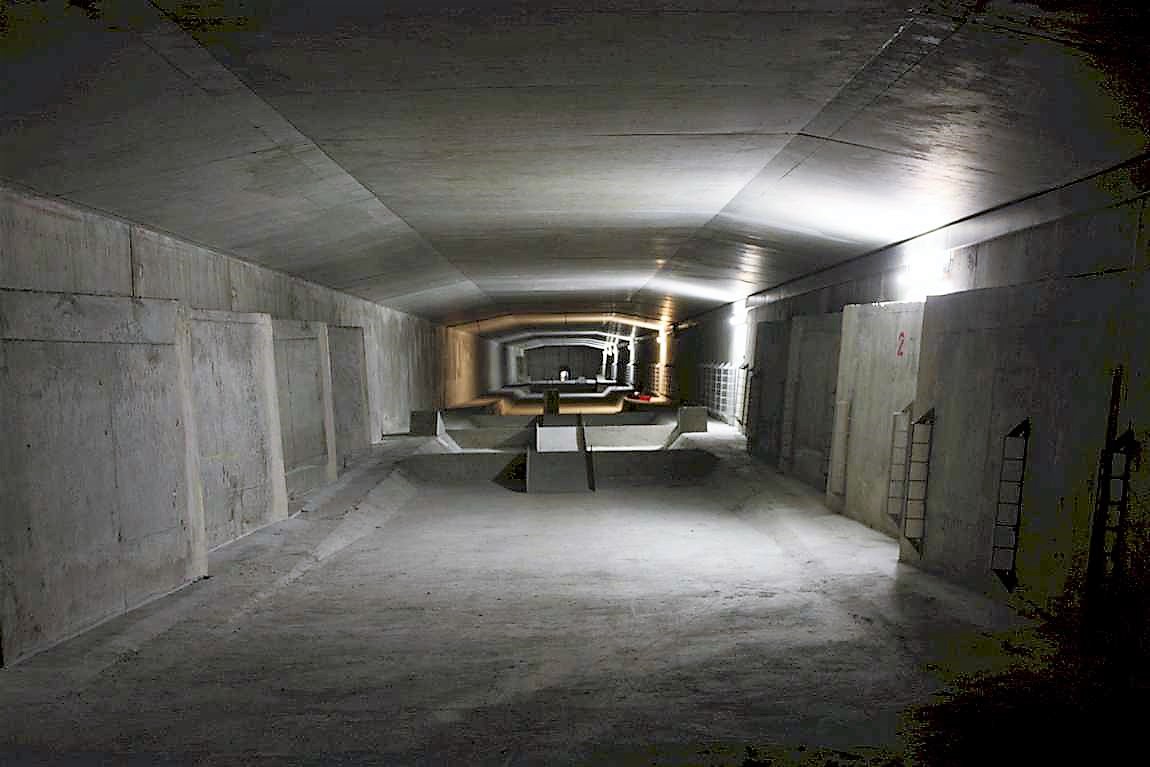
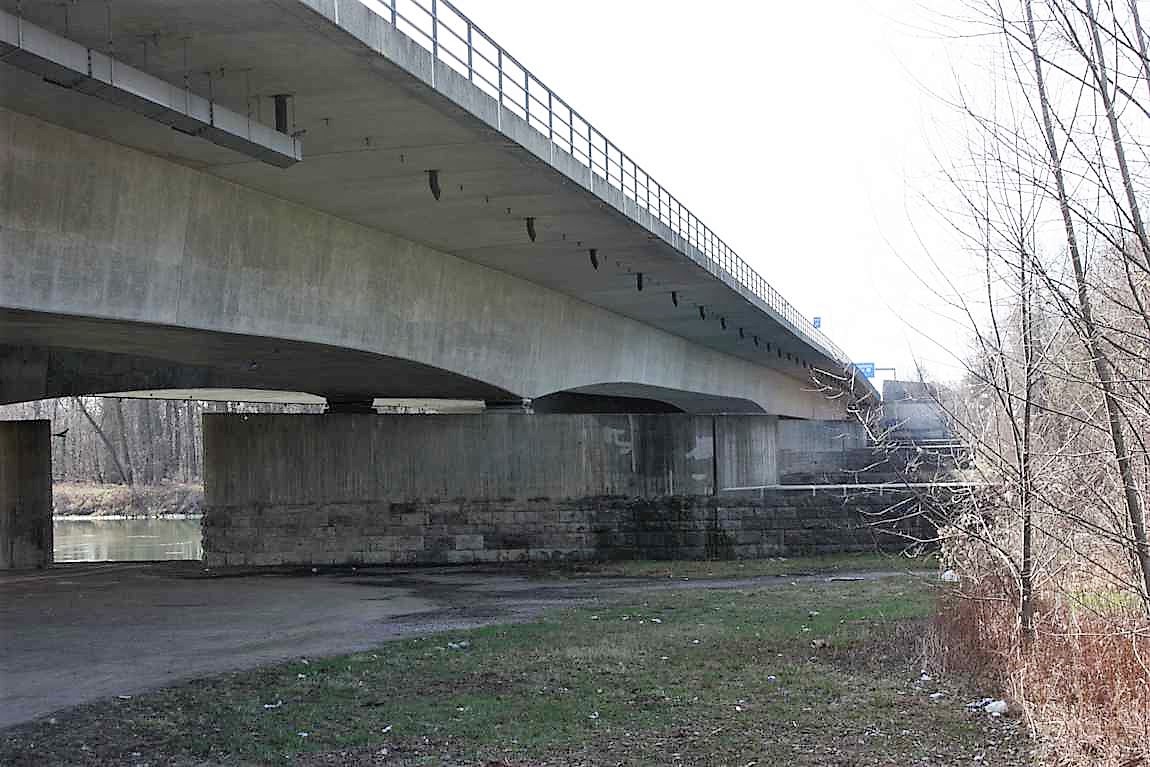
The Donaubrücke Ingolstadt was built in 1977 using the incremental launching method, with one superstructure for each directional lane. The typical cross-section is a single-cell box girder with variable structural height (4.40 m in the southern foreland spans, 3.35 m in the river span and in the northern foreland span). The thickness of the bottom slab varies in the regular area from 20 cm to 50 cm and is up to 1.05 m in the area of axes 1 and 2.
The superstructures were “partially prestressed” with subsequently grouted tendons in the longitudinal and transverse directions, in accordance with DIN 4227, which was valid at the time. The eastern superstructure relevant here (direction of travel from Munich to Nuremberg) continuously spans five fields with spans of 54.0 m to 115.0 m. The total length of the superstructure is approximately 378.45 m.
The production took place in 19 cycles (cycle length approx. 20 m). The cycle cellar was located in the area of the southern abutment (axis 5), the shifting took place towards the north. For each cycle, the trough cross-section (bottom slab + webs) and then the roadway slab were concreted.
In the course of the recalculation, structural safety deficits were identified in recalculation levels 1 and 2. These essentially include the connections of the compression chords in the support areas (bottom slab) in the superstructure. In addition, the curvature of the bottom slab results in additional local bending stresses, which were originally not sufficiently taken into account.
In level 1, the recalculation was carried out in accordance with the guideline with the load assumptions in accordance with the current DIN technical report 101 and the dimensioning in accordance with the current DIN technical report 102. In level 2, the possible modifications of the partial safety factors on the material side, a favorable approach to the concrete strength and the possible reduction of the compression strut angle for the chord connections were applied.
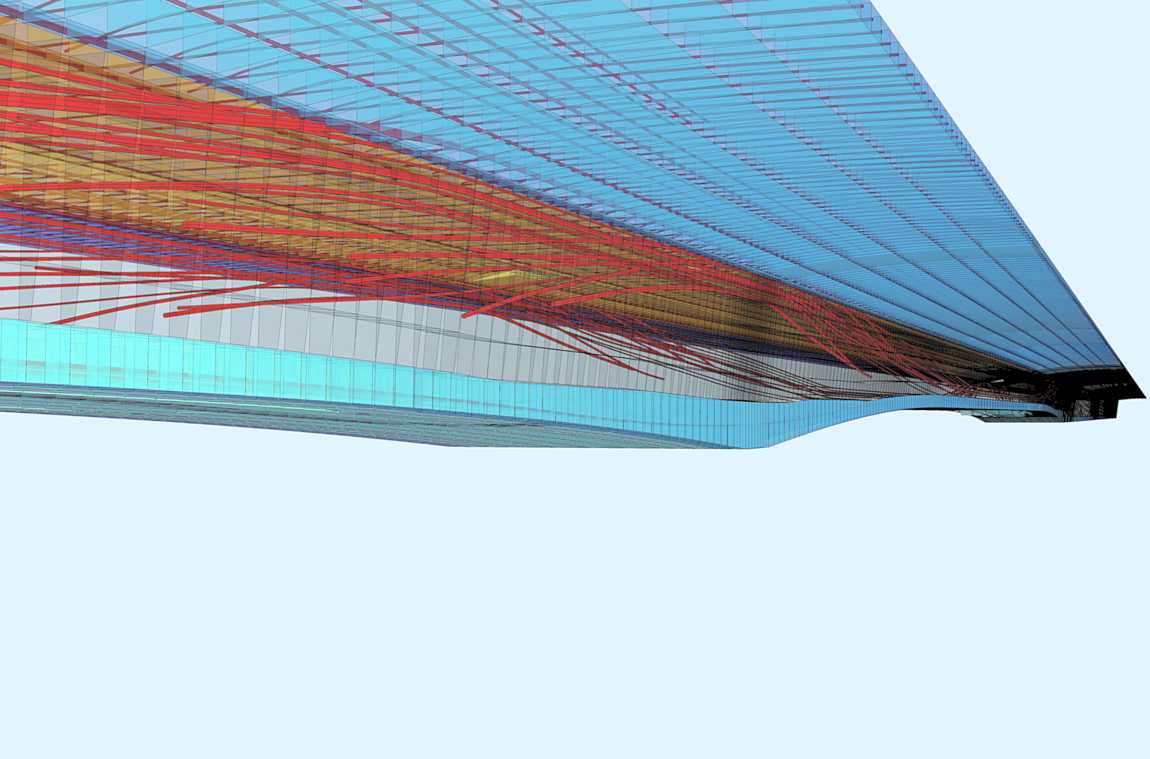
Subsequently, investigations were carried out for the areas with identified deficits in accordance with level 4 of the recalculation guideline. For this purpose, on the one hand, strength tests were carried out on drilled cores that were extracted from the lower chord panels of the structure in order to obtain improved strength values for the recalculation. On the other hand, a non-linear structural calculation was carried out on a folded plate model using the non-linear load-bearing capacity reserves (the calculations in levels 1 and 2 were carried out on a member model using standard calculation and dimensioning methods in accordance with the current standard).
It could be shown that, despite considerable undercoverage of the chord connection reinforcement compared to the dimensioning results according to standard dimensioning, there is sufficient load-bearing capacity using the non-linear structural reserves.
Special features
- Pilot project for the application of the recalculation guideline in Bavaria
- 5-field highway structure with a very slender river span
- Recalculation according to level 1-4 of the recalculation guideline
- Non-linear calculation on the folded plate model of the entire superstructure, including the results of strength tests on the structure