B+S
Location |
Client |
Service |
Category |
Completion |
Description
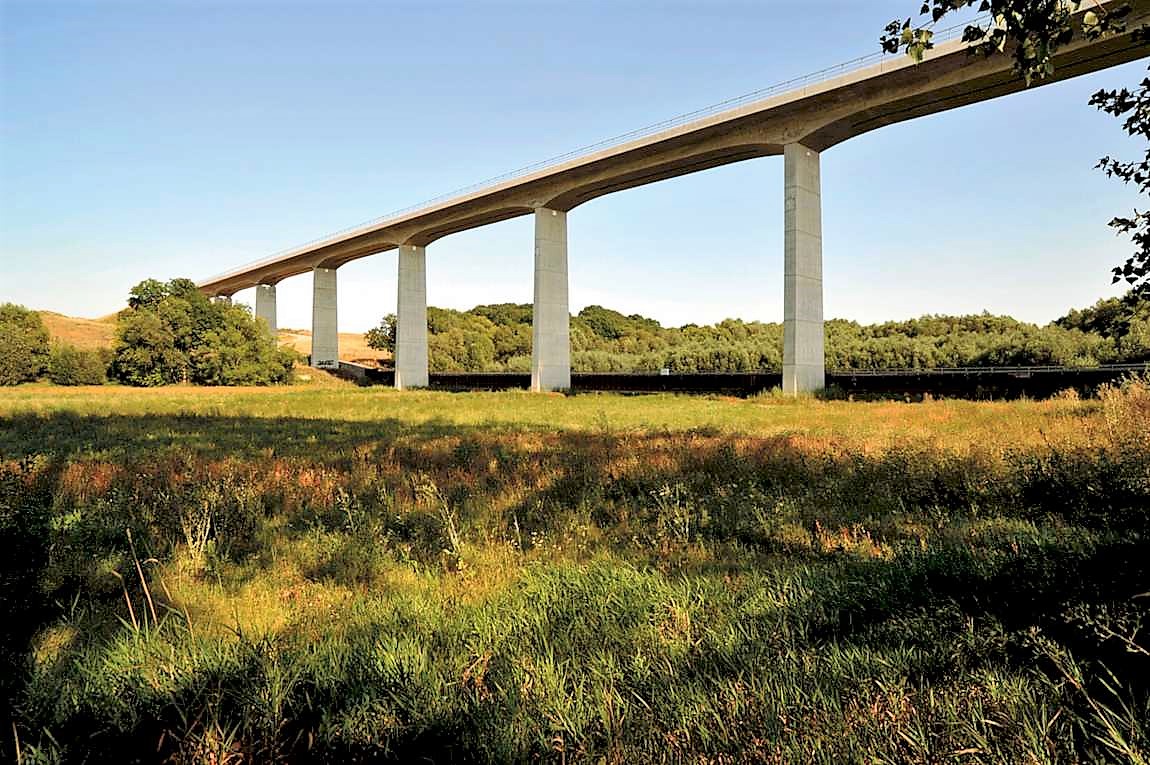
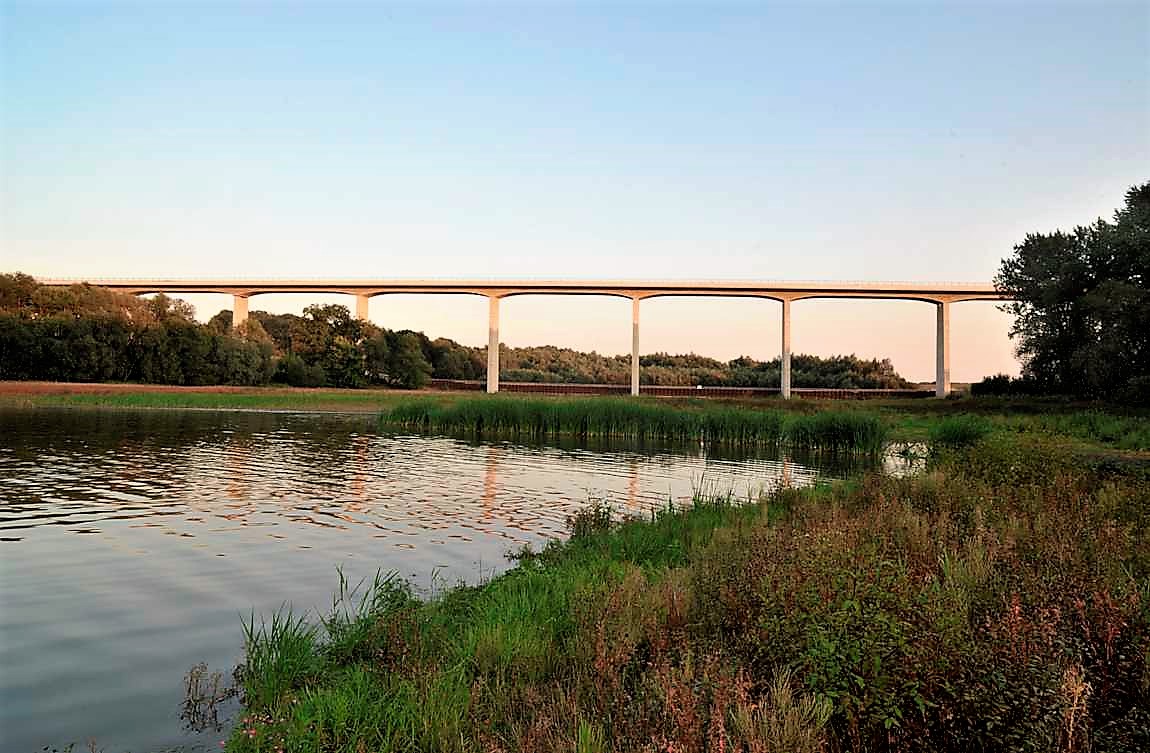
The superstructure of the Scherkondetal Bridge is a 14-field continuous beam. It is designed as a wide beam in prestressed concrete construction with a structural height of h = 2.0 m in the field area. To absorb the support moments, the structural height at the supports is increased to h = 3.50 m by means of haunches. The superstructure is monolithically connected to the western abutment and to the piers. The piers are slender solid wall panels with a constant thickness of 1.50 meters. In the transverse direction, the piers have a width of 5.50 meters at the top and a continuous pier fitting of 1:40. The deformations of the structure due to temperature, creep and shrinkage can be absorbed by the flexibility of the piers in the longitudinal direction of the structure. As a result of the resulting constraint forces in the system, a monolithic connection of the substructures to the superstructure could not be realized in pier axes eleven and twelve and on the eastern abutment in axis 13, so that longitudinally movable spherical bearings are installed here. To absorb the longitudinal forces, the abutment in axis 0 is designed as a fixed point. At the opposite end of the structure in axis 13 is the expansion joint, which absorbs the deformations. The abutments and piers were founded in the existing mudstone with large bored piles of up to 19 meters in length.
Special features
- Semi-Integral Construction Method: Clamped pillars with a fixed point distance of 452 m, first-time execution of this unregulated construction method (with ZIE) for railway bridges of this length
- Extensive measurement program to check the assumptions made in the static calculation
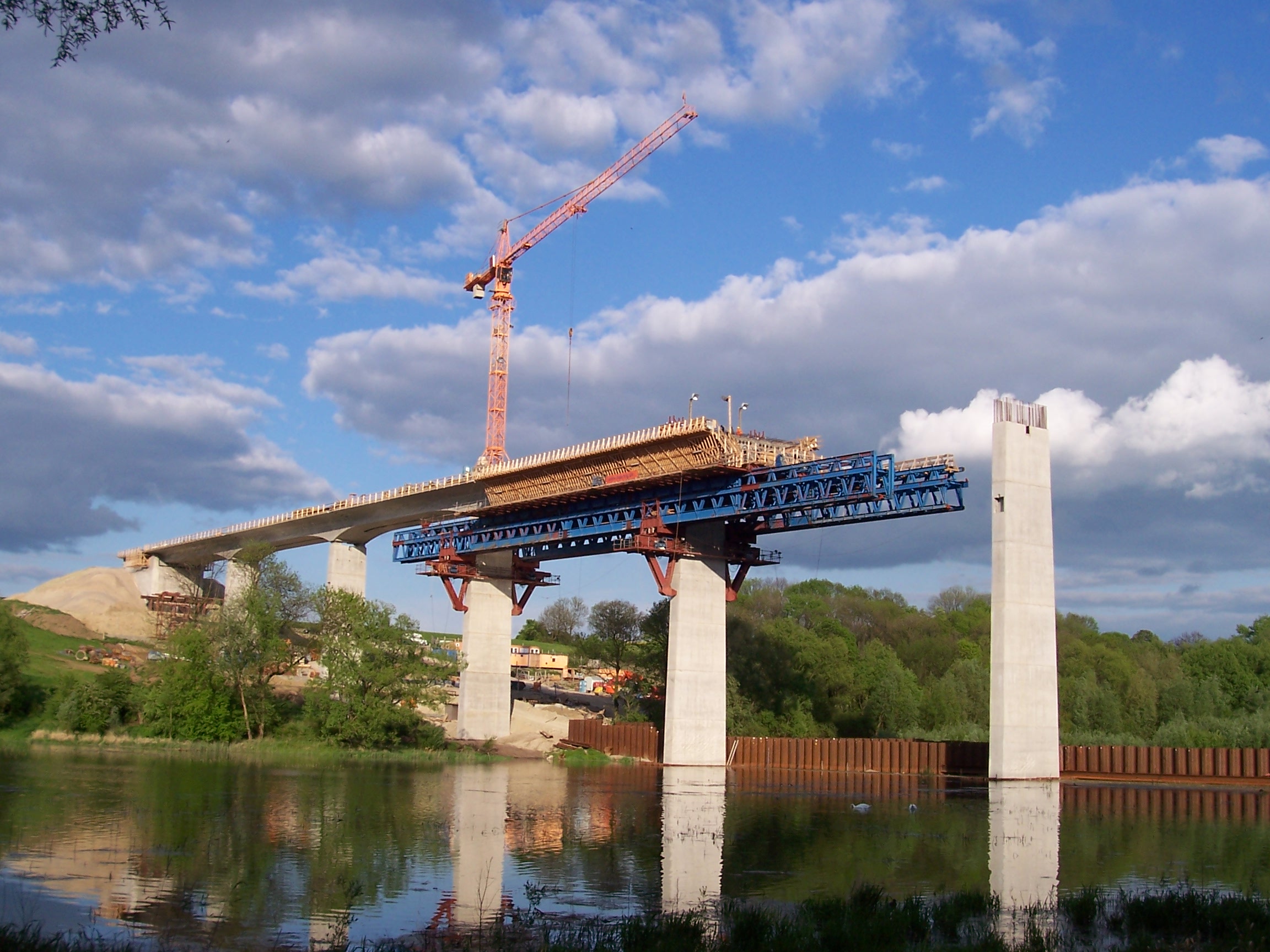
- Manufacture using a lower, pier-supported scaffolding. The pillars were partially manufactured at an angle according to plan so that they are vertical in the final state
- Temporary fixed point in the construction state is at the superstructure end that is longitudinally movable in the final state
- Consideration of the load case `Braking/Braking`
In 2010, the Scherkondetal Bridge received the Civil Engineering Award from Ernst & Sohn and in 2012 the German Bridge Construction Award. According to the jury, the Scherkondetal Bridge is “An aesthetically convincing, innovative structure and a milestone in modern railway bridge construction for high-speed traffic.”
Other
Award for Civil Engineering Ernst & Sohn
(Finsterwalder Ingenieurbaupreis) 2010
The jury justifies the award with the “outstanding engineering achievement in the field of bridge construction”
German Bridge Construction Award 2012
(Project Manager Execution Planning: Dipl.-Ing. Stephan Sonnabend, Büchting + Streit AG)
According to the jury’s verdict, it is an aesthetically convincing, innovative structure and a milestone in modern railway bridge construction for high-speed traffic. This is exactly what was achieved with the bridge over the Scherkonde Valley in the Weimar region, the jury found. As the first semi-integral railway bridge of Deutsche Bahn AG, it sets standards both in terms of design and structural engineering. The almost jointless and bearingless construction enabled an economical and sustainable structure that also blends in wonderfully with the landscape. This bridge, which appears light and elegant compared to many older railway bridges, is a prototype of a new generation of railway bridges. With the realization of this building, Deutsche Bahn AG has shown courage and broken new ground.
The jury is convinced that the Scherkondetal Bridge is also an excellent showcase of innovative German engineering on an international scale.
The bridge was consistently designed in concrete construction in a way that was appropriate for the material. Of decisive importance is the chosen pile foundation, which on the one hand is flexible in the event of stress and at the same time does not allow any significant settlement differences to be expected. The relatively stiff, prestressed concrete superstructure ensures that the railway bridge offers sufficient stability to the track systems and sufficient resistance to deformation. Ludolf Krontal from DB ProjektBau and Stephan Sonnabend from the Büchting + Streit office received the German Bridge Construction Award 2012 for the outstanding engineering achievement that went into this structure.
Publications
Sonnabend, S.; Tiarks, F.:
The Scherkodetal Bridge along the NBS Erfurt-Halle/Leipzig; Special features in the execution planning and construction of the structure in semi-integral construction.
In: Proceedings of the 20th Dresden Bridge Construction Symposium. Dresden 2010
Marx, S; Bösche, T.; Sonnabend, S.:
Construction-accompanying measurement program to check the computational load and system assumptions during the construction of the Scherkondetal Bridge
5th Symposium “Experimental Investigations of Building Structures”.
In: Konstruktiver Ingenieurbau Dresden, Issue 18, pp. 45-56. TU Dresden 2009
Sonnabend, S; Marx, S.; Bösche, T.:
Scherkonde Viaduct – A Semi-Integral Railway Bridge for High-Speed Traffic.
In: Proceedings of the 8th Japanese German Bridge Symposium. Munich 2009.
Marx, S; Sonnabend, S.; Bösche, T.:
Design and realization of the Scherkondetal Bridge – A semi-integral railway bridge for high-speed traffic
In: Proceedings of the German Construction Technology Day. April 2009, Dresden
In: Deutscher Beton – und Bautechnik-Verein e.V.. DBV-Heft No. 15. 2009, Berlin