B+S
Location |
Client |
Service |
Category |
Completion |
Description
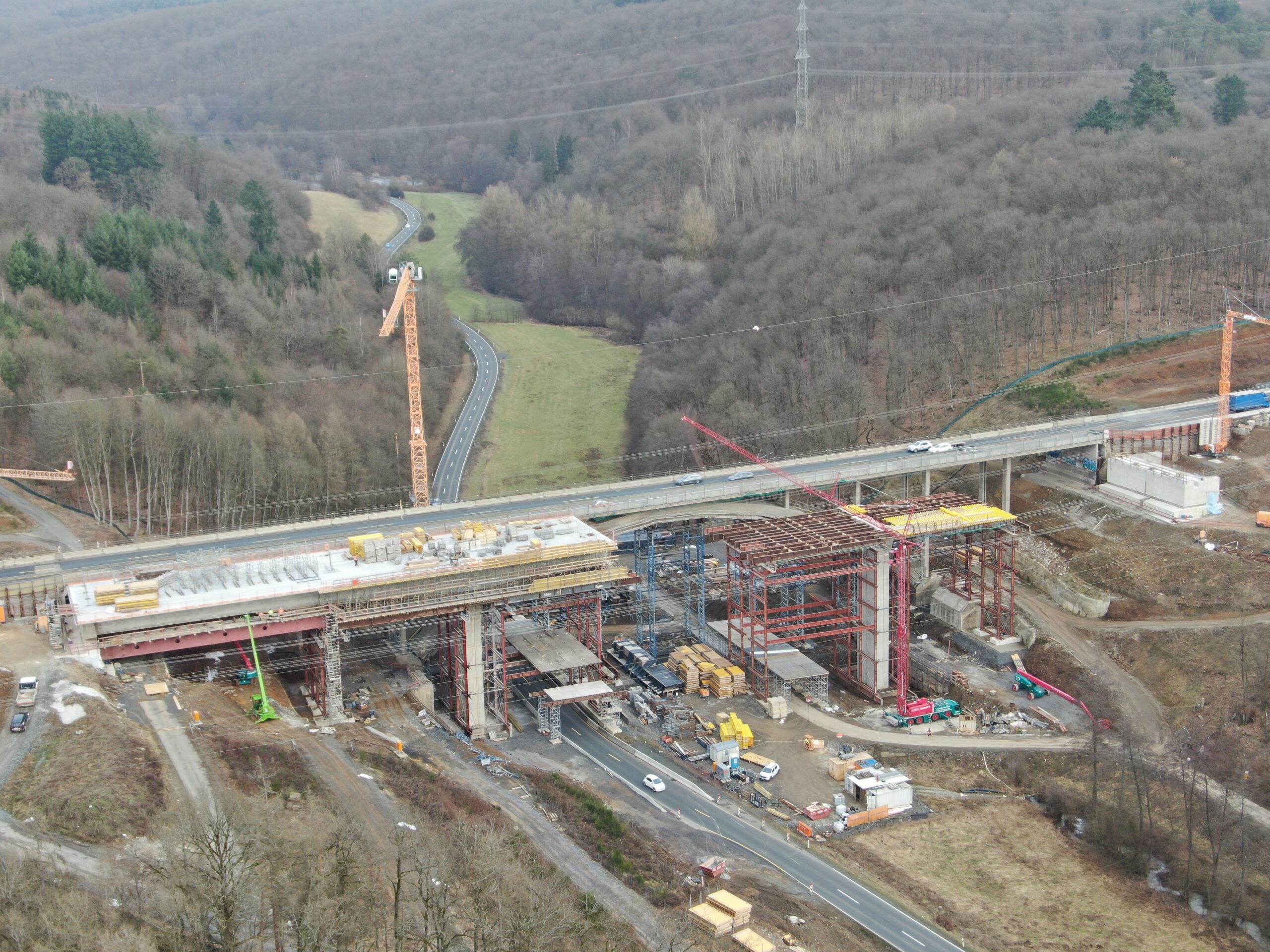
The Bechlingen Valley Bridge is located between Dortmund and Gießen along the A 45 federal highway. Due to identified deficits in the recalculation of the Bechlingen Valley Bridge along the A 45, the two sub-structures of the existing arch bridge must be replaced by a new construction. Here, the A 45 runs over the valley of the Bechlinger Bach, the L 3376, and three agricultural roads. The valley bridge is located near a district of Aßlar called Bechlingen in the Central Hessian Lahn-Dill district. Due to the sharply increased traffic loads and the high proportion of heavy goods traffic, the existing structures of the Bechlingen Valley Bridge are no longer sustainable, so that a replacement new building is required. In the future, the A 45 federal highway in the area of the bridge is to be expanded to six lanes.
The A 45 highway runs in the area of the structure over approx. 60 m in a straight line and over approx. 120 m in the transition curve (left curve) with R ≈ 1,000 m at the bridge end. The gradient of the valley bridge lies in a trough rounding, whereby the longitudinal inclination in the structure area varies between approx. 0.55 % and approx. 1.15 %. In the area of the structure, the gradient of the A 45 is up to approx. 31 m above the valley floor.
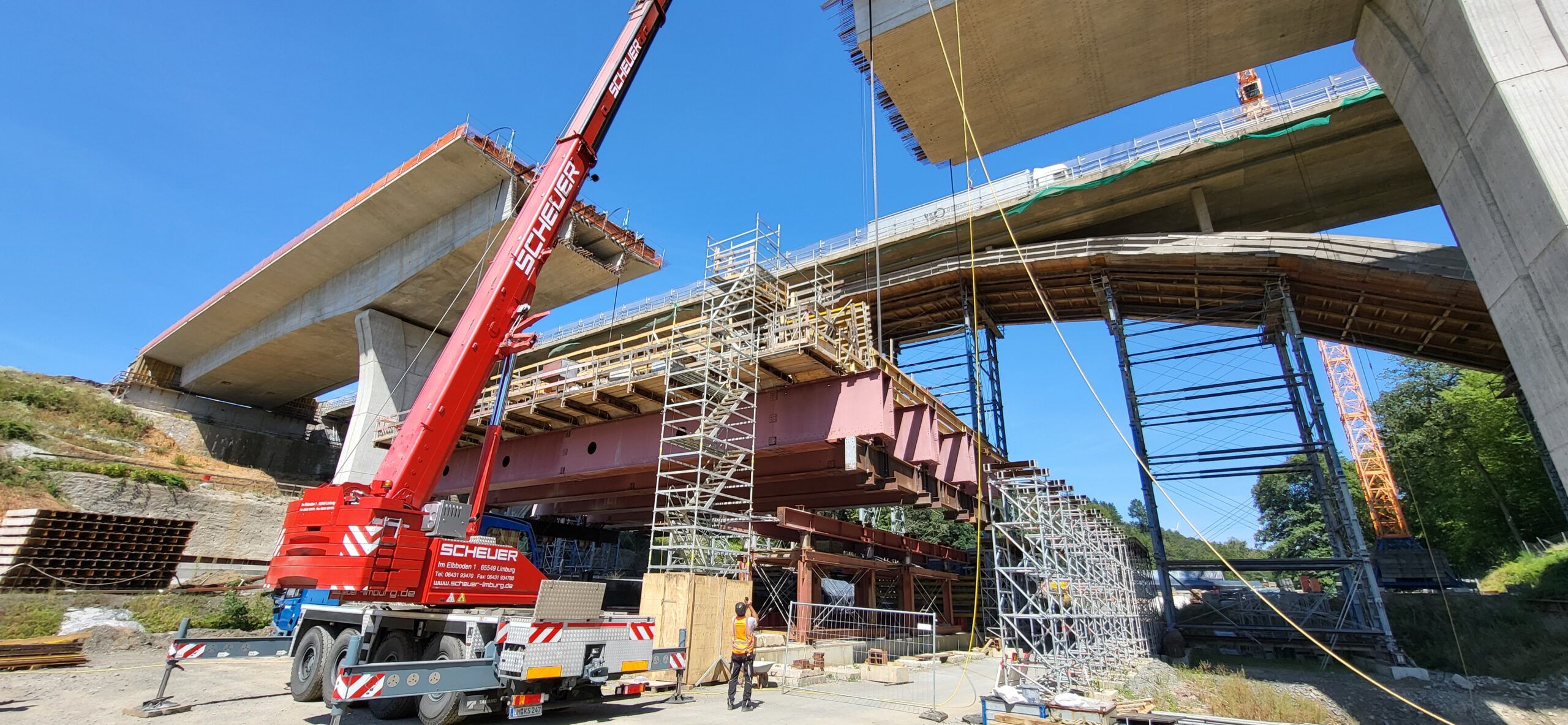
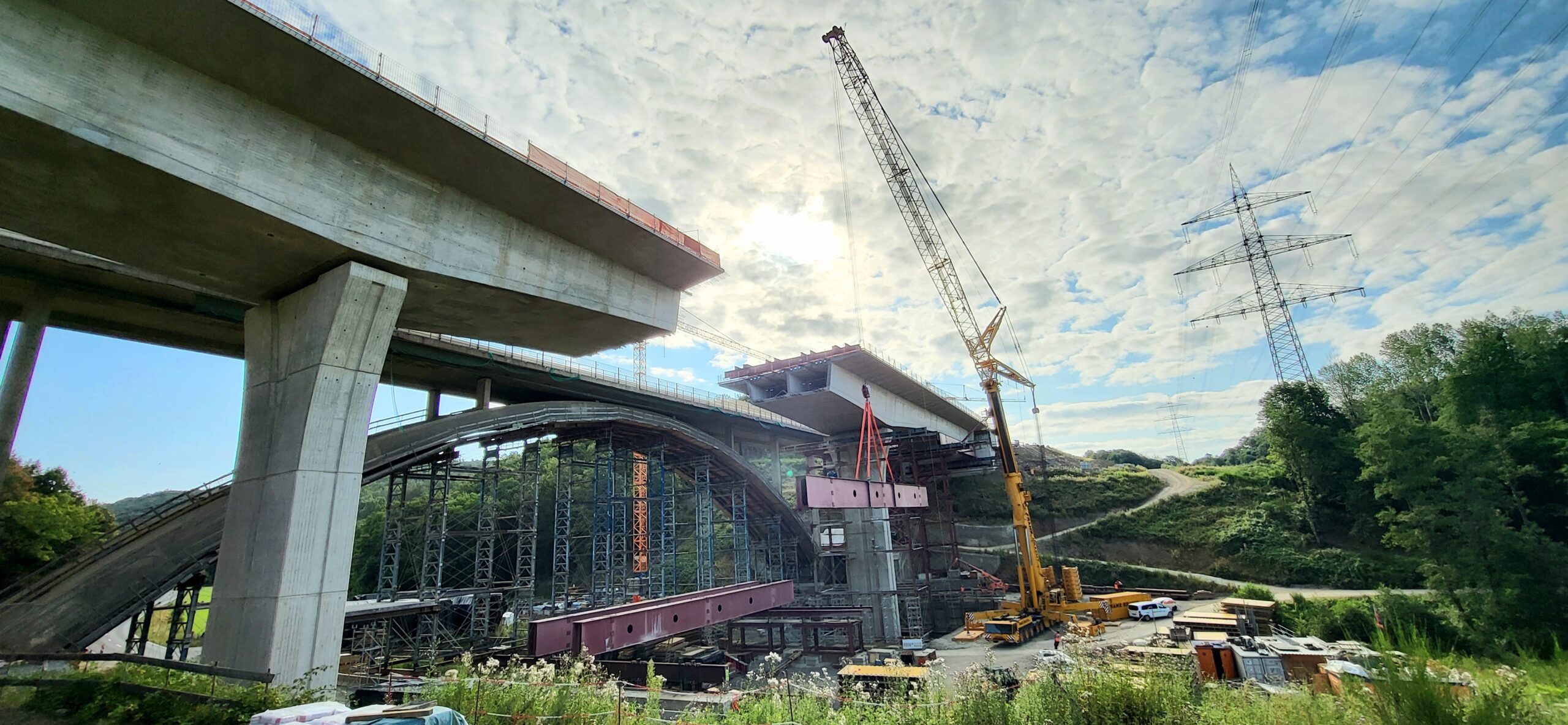
The replacement construction of the Bechlingen Valley Bridge is realized as a three-field prestressed concrete superstructure with spans of 54.60 m in the two edge fields and 70.00 m in the center field. The total length of the bridge structure in the highway axis is 179.20 m. The lower edge of the cross-section follows a parabolic course, whereby the cross-sectional heights vary between 3.30 m at the end of the edge fields and in the field center of the main field and 5.10 m in the pier axes. The superstructure cross-section is realized as a two-cell longitudinally prestressed prestressed concrete box girder in composite construction with external and internal prestressing.
Due to the requirements for maintaining the stopping sight distances, the two superstructures cannot be guided in parallel. As a result, an independent alignment of the directional carriageways in the structure area is required. For the superstructure of the directional carriageway Hanau, the entire cross-sectional width between the cap outer edges is 20.507 m. For the directional carriageway Dortmund, there is a maximum cross-sectional width of only 18.50 m, whereby the cross-sectional width, which is 2.00 m smaller compared to the directional carriageway Hanau, is achieved by reducing the cantilever arm lengths by 1.00 m each.
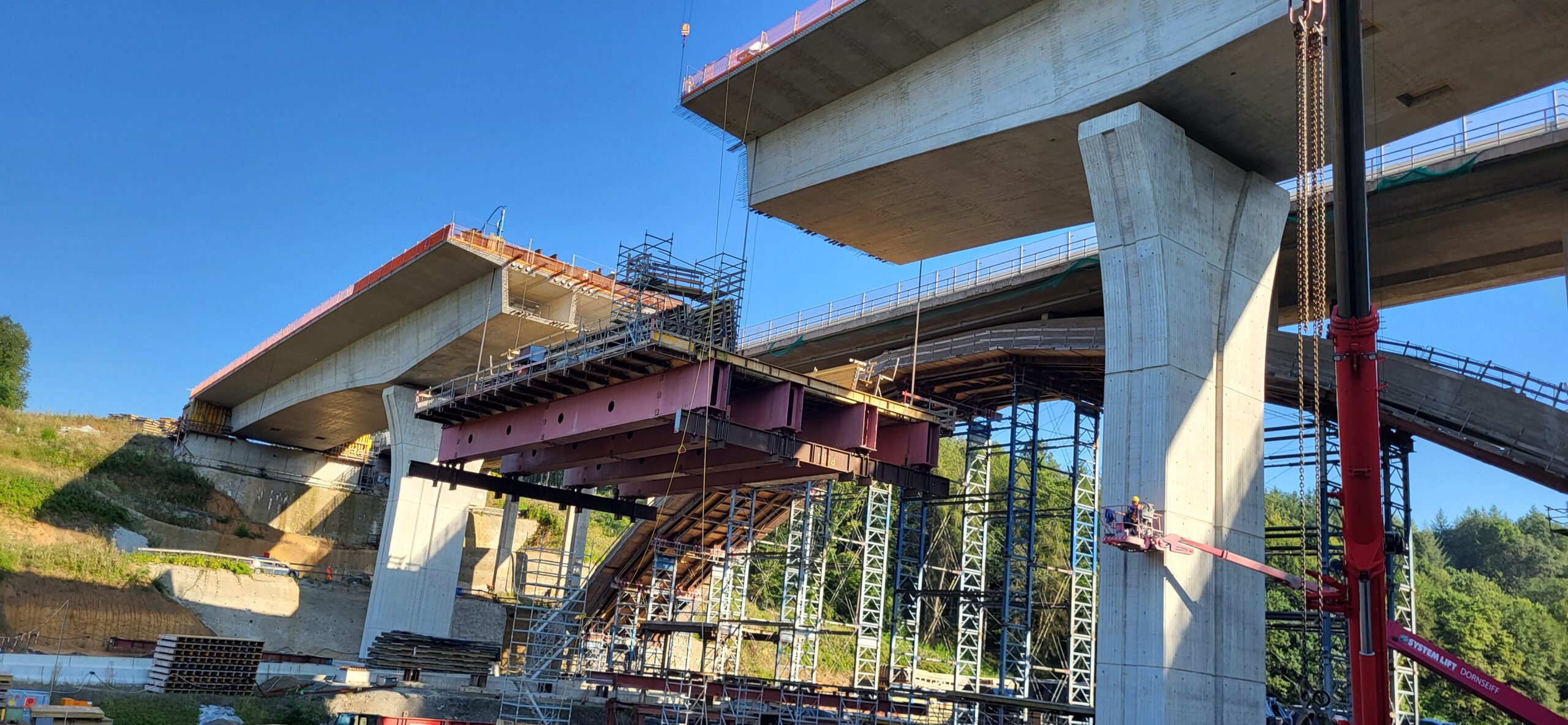
Due to the manufacture of the superstructure on a ground-supported or suspended on the coupling joints falsework, there were some special features that had to be observed in the course of planning and execution.
Special features
Consideration of the interaction between superstructure and falsework during the production of the two-cell box girder in several concreting sections (related to the cross-section and related to the longitudinal direction); Consideration of the proportional load transfer between the formwork and trough during concreting of the roadway slab (analogous to VSG)
Special requirements for the analysis of the influences on profile deformation in the superstructure verifications in the bridge longitudinal direction