B+S
Location |
Client |
Service |
Category |
Completion |
Description
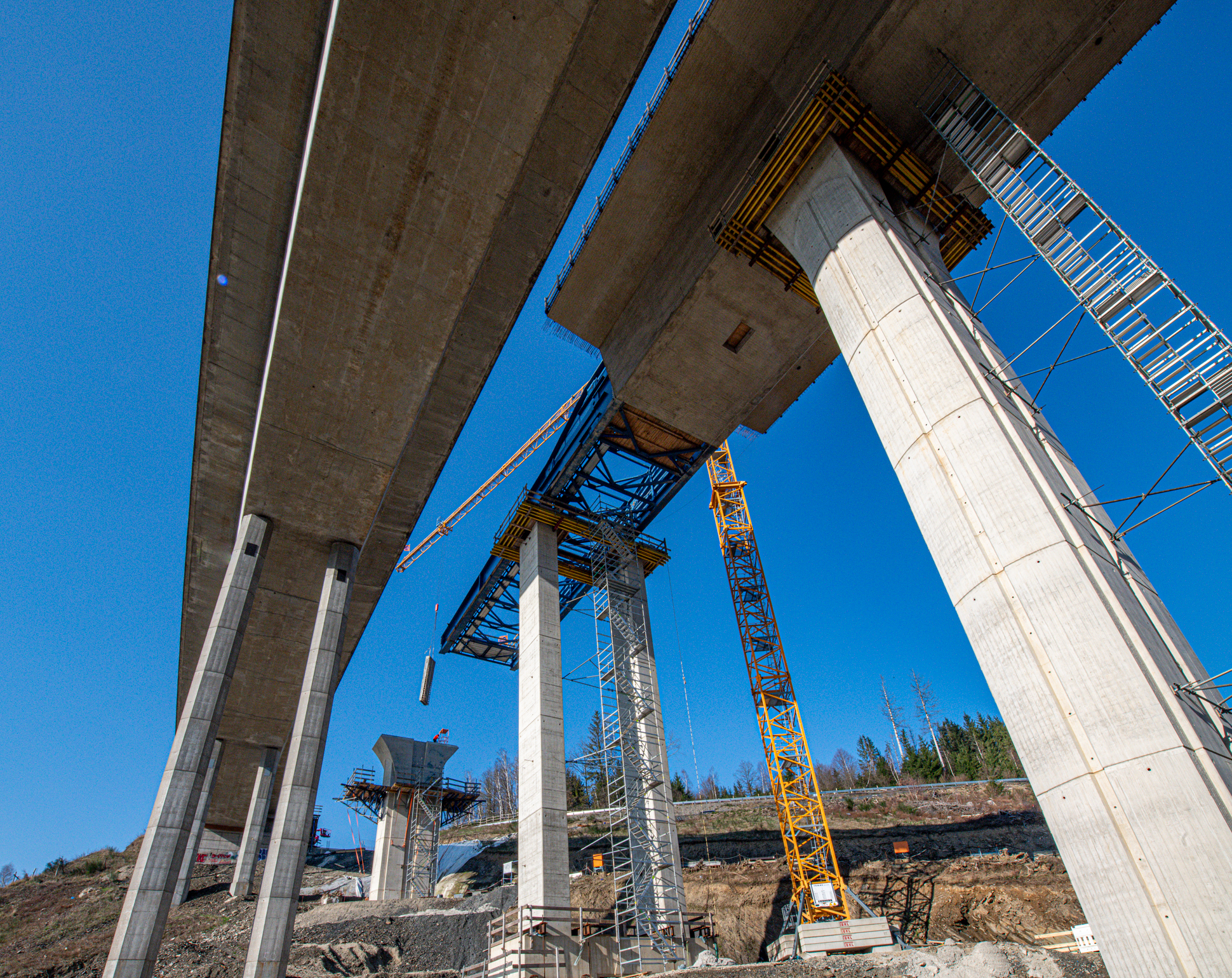
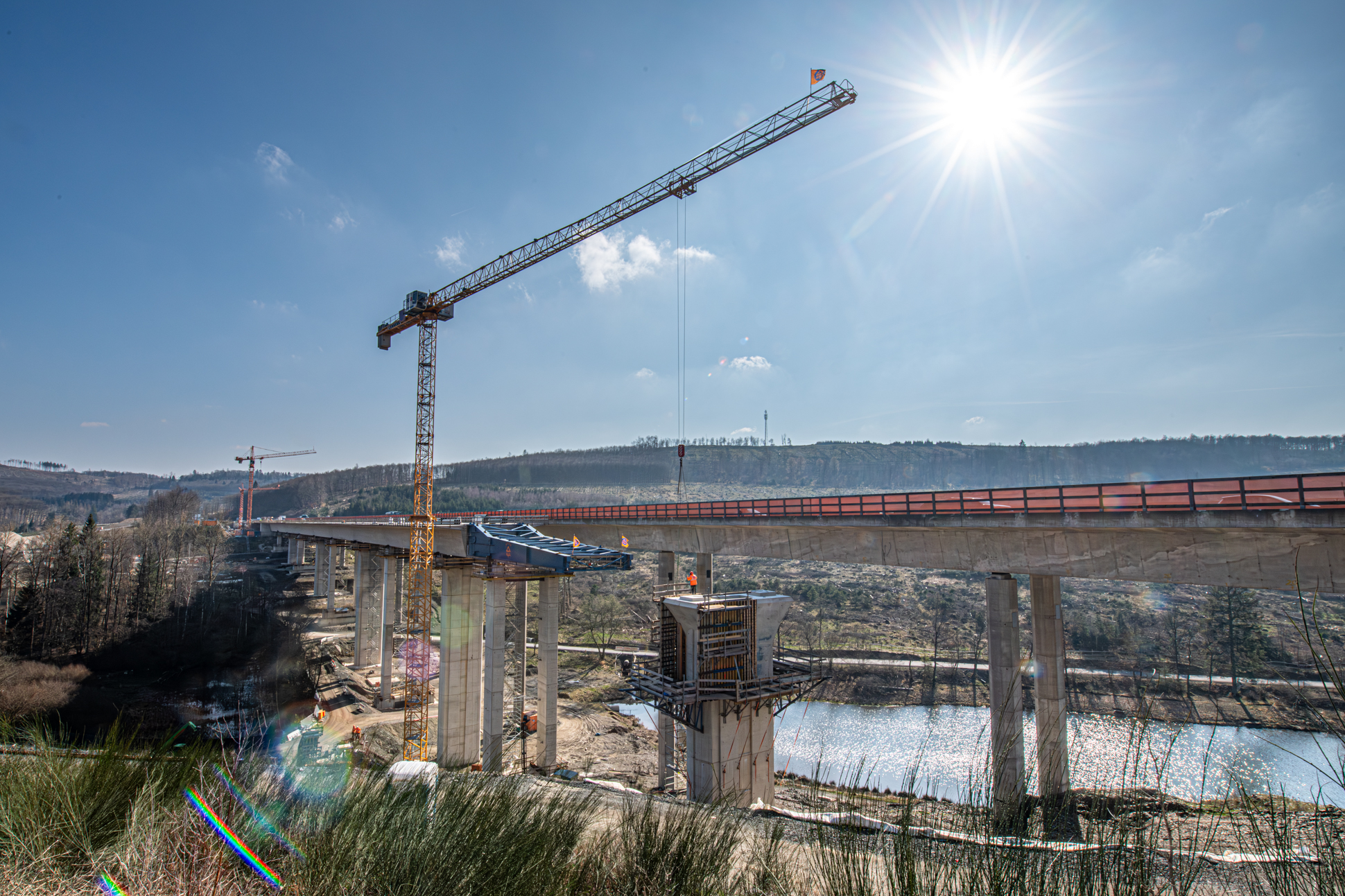
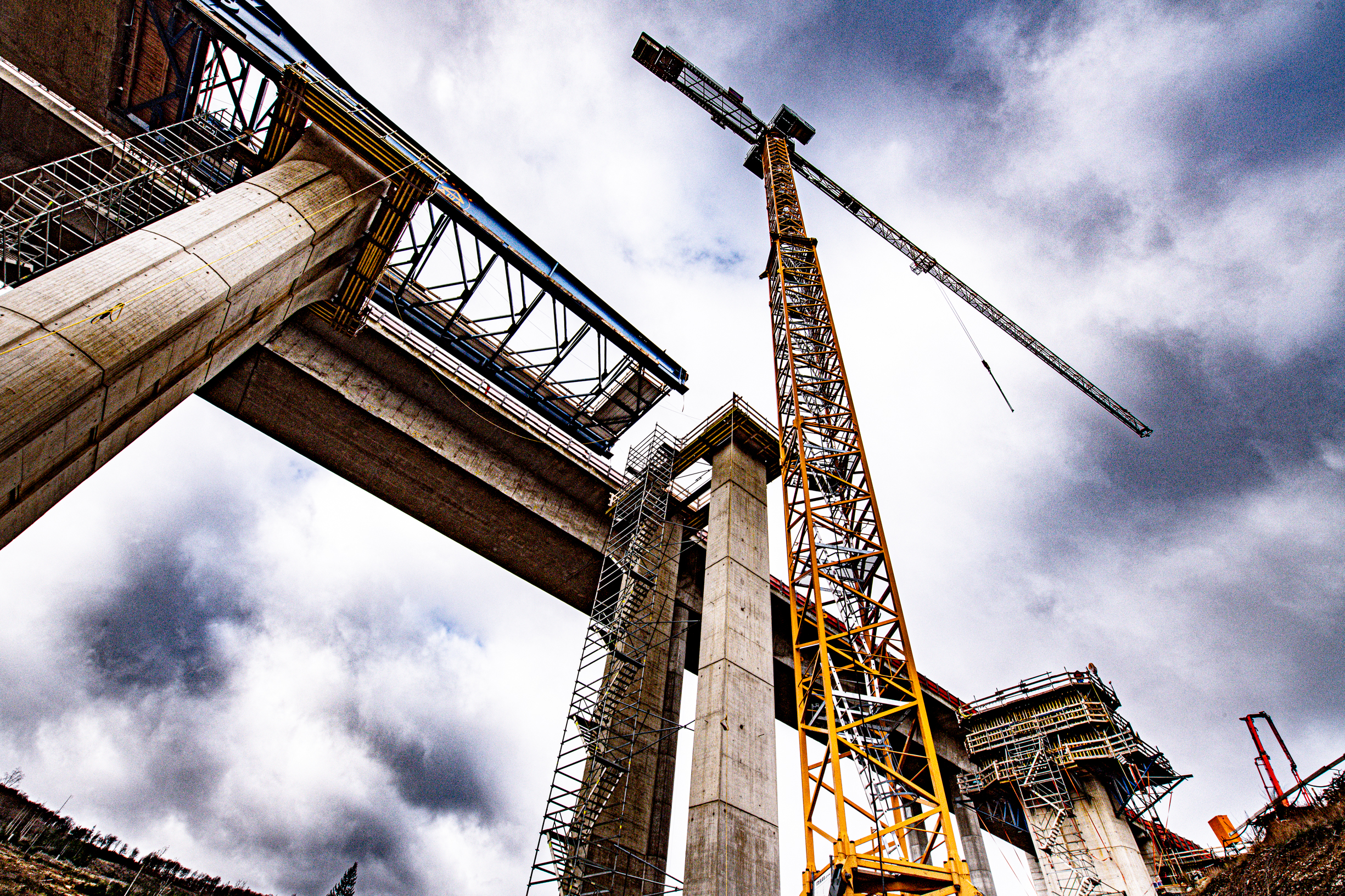
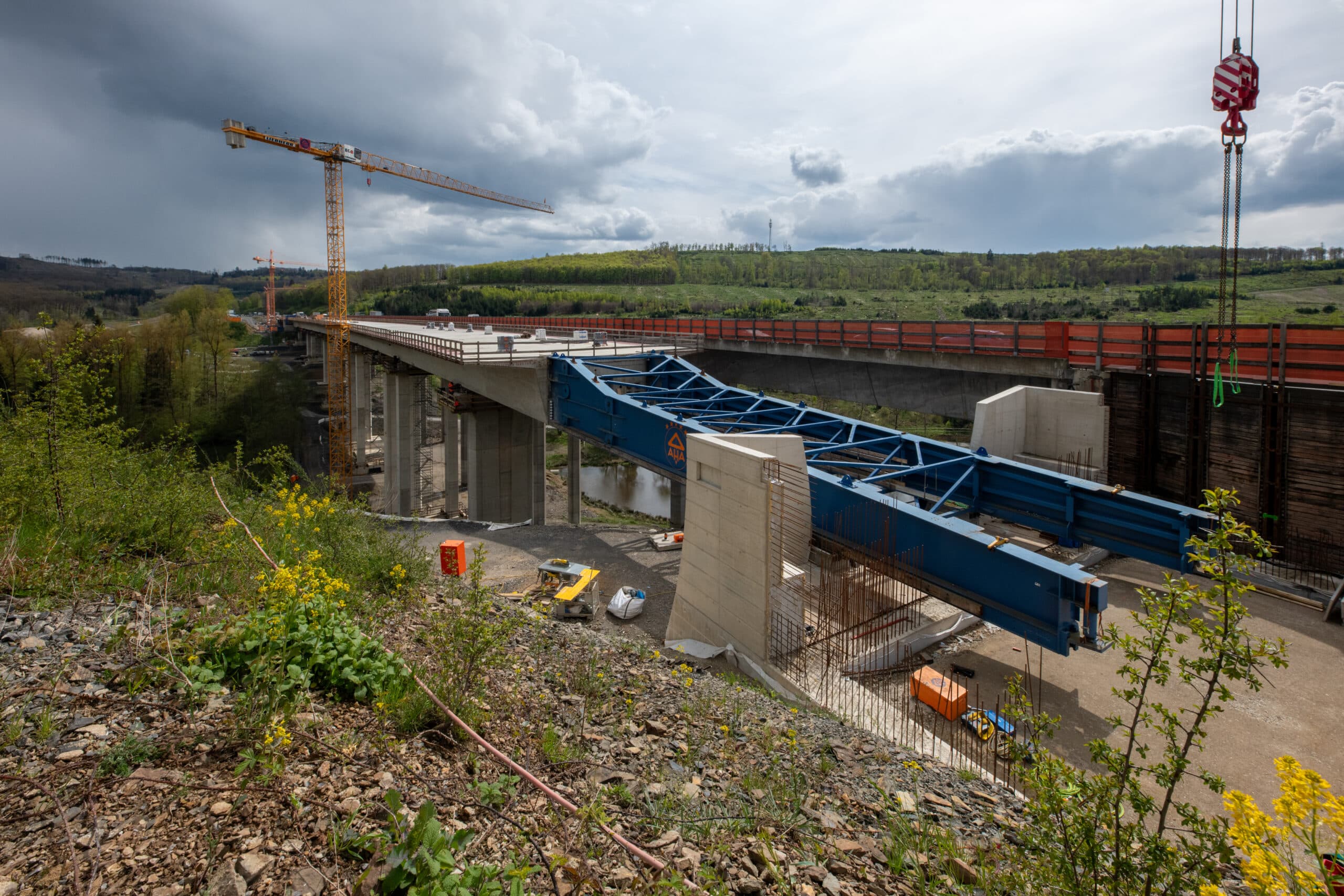
The Landeskroner Weiher Valley Bridge is located in North Rhine-Westphalia, north of the state border with Hesse, on the section of the A 45 between the Haiger-Burbach junction (AS) and the Wilnsdorf junction in the vicinity of the Wilnsdorf locality. The two superstructures of the replacement structure are each realized as a single-cell hollow box with a structural height of h = 4.50 m in prestressed concrete composite construction over six spans. The span widths are 47.00 m + 63.00 m + 71.50 m + 2 × 72.50 m + 58.00 m for the direction of travel (FR) Dortmund and 42.00 m + 65.00 m + 3 × 72.50 m + 58.00 m for the FR Frankfurt. The total lengths in the highway axis are thus 384.50 m (FR Dortmund) and 392.50 m (FR Frankfurt). Both superstructures are manufactured using the incremental launching method, each being launched uphill from the abutment in axis 70 towards the abutment in axis 10.1 or 10.2 in 17 cycles. The total width of the superstructures between the railings is b = 36.30 m, which is divided equally between the superstructures of both directional carriageways. In the ground plan, the gradient runs in the structural axis, coming from the abutment in axis 70, up to shortly before the piers in axis 20.1 or 20.2 in a radius of R = 4021.709 m. This is followed by a clothoid with A = 552.612 m beyond the abutments in axis 10.1 and 10.2. Due to this alignment and taking into account the clearance dimensions of both hollow boxes, a replacement radius in the hollow box axis results for the superstructure of the FR Dortmund (Frankfurt) of R = 4012.734 m (R = 4030.684 m). In elevation, the gradient of both superstructures runs in a constant longitudinal inclination of 0.50%. Deviating from this, the superstructure of the FR Dortmund follows a crest rounding with R = 48,000 m from 19.00 m before the pier in axis 20.1. Since both superstructures are launched with a constant longitudinal inclination of 0.50%, the superstructure of the FR Dortmund must be lowered by 46 mm after reaching its final position at the abutment in axis 10.1 and by 4 mm at the pier in axis 20.1 in order to ultimately lie in the actual gradient in elevation. The structure is only prestressed in the longitudinal direction with internal tendons in the subsequent composite and external tendons. Auxiliary supports were used for the launching process.
Special features
The production took place on auxiliary supports in each field, whereby the auxiliary supports from the production of the
first directional lane were laterally displaced and also used for the production of the second directional lane.
bahn.