B+S
Location |
Client |
Service |
Category |
Completion |
Description
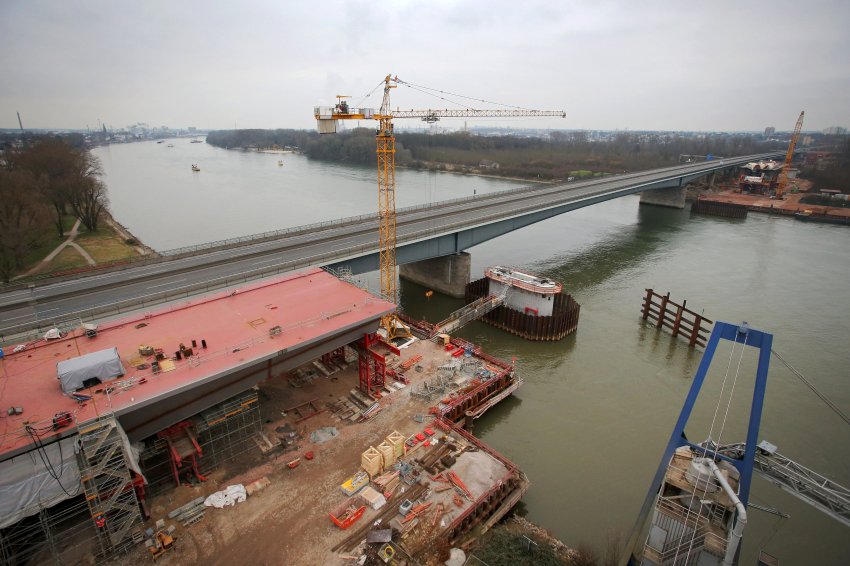
The structural condition of the existing Schierstein Bridge (completed in 1962) has significantly deteriorated in recent years. In addition, since the opening of the bridge to traffic, the proportion of heavy goods traffic, the permissible axle loads, and the total traffic volume have increased considerably (as of 2012: over 90,000 vehicles/24h). An expert assessment concluded that there is a risk of sudden brittle fracture in the area of the longitudinal stiffeners of the road construction and that retrofitting is not possible. Therefore, the Schierstein Bridge (both carriageways) is currently being replaced by corresponding new constructions. The superstructures are box girders, partly as a pure steel cross-section (in the area of the maximum spans), partly as a composite steel cross-section. A prestressed concrete frame bridge forms the end on the Wiesbaden side. The bridge extends over 14 fields with 2 large river openings. Each direction of travel receives a separate bridge, the width between the railings being 21.10 m in each case. The eastern bridge is located in the route of the previous structure.
Due to the exposed location of the Schierstein Bridge and the importance of the areas spanned by it for nature and landscape, and the urban connection, especially on the Wiesbaden side, there are high demands on the design of the new bridge. Therefore, a design competition was held in advance to find functional, economical, design-related, and structurally sound solutions that convincingly address the urban planning, architectural, landscape planning, and ecological conditions. The solution awarded by the competition jury (1st prize: Grontmij BGS-Ingenieurgesellschaft & Architekturbüro Ferdinand Heide, Frankfurt am Main) was planned for execution by B+S together with the Weyer Ingenieure office (steel construction planning). Due to the realization of an award-winning competition design, the transfer of the design concept into concrete technical implementation and the development of detailed points also required an interdisciplinary approach and the consistent consideration of architectural concerns.
B+S AG created the execution planning for all steel/prestressed concrete components.
Special features
- Realization of an exposed structure under ongoing traffic and with extensive
consideration of design aspects - Foundation on bored piles d = 180 cm, partly pier axes/foundation in the river area
- Two existing river piers of the previous bridge structure are being upgraded and further
used, land piers in Y-shape for design reasons - Maximum span 205 m, haunched cross-section with a structural height between 3.30 and 8.30 m
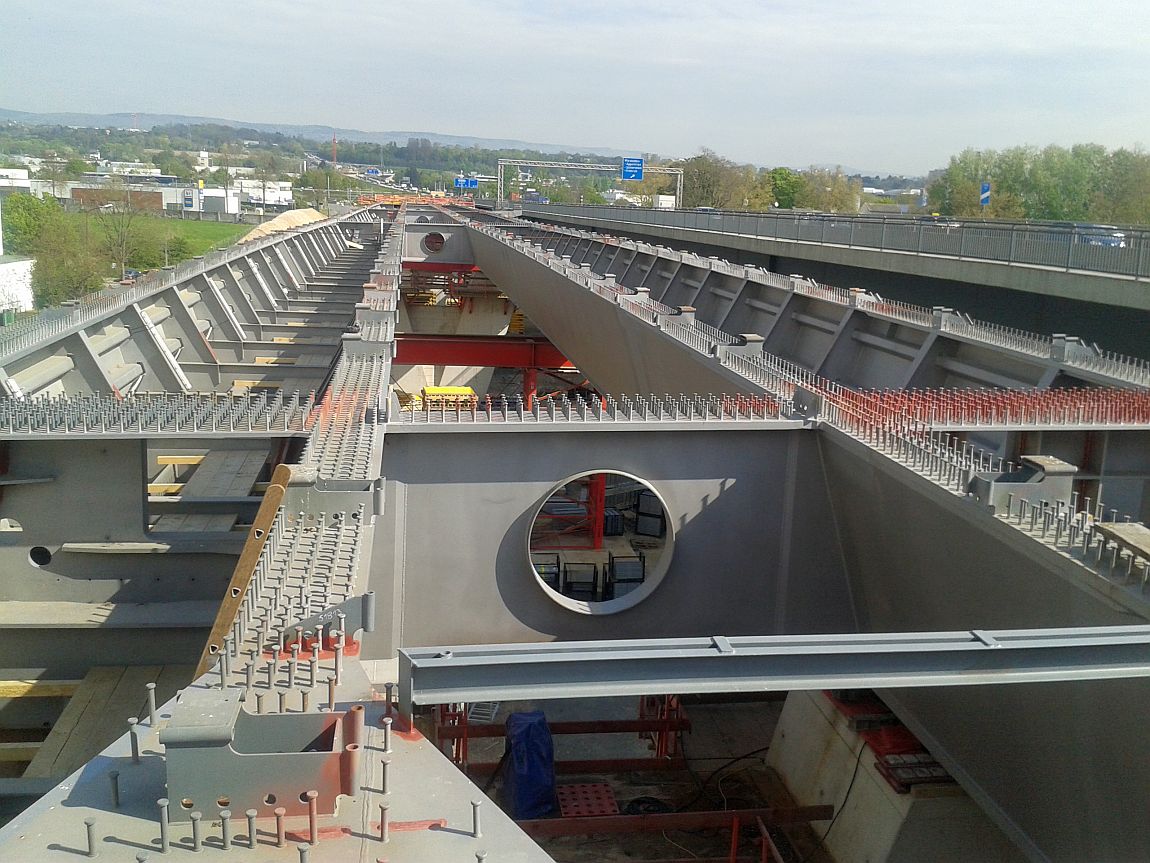
- Superstructure partly as a 1-cell steel box girder (in the area of the main spans), partly
as a two-cell composite box girder, partly prestressed concrete precast frame bridge - River spans are floated in