B+S
Location |
Client |
Service |
Category |
Completion |
Description
Deconstruction:
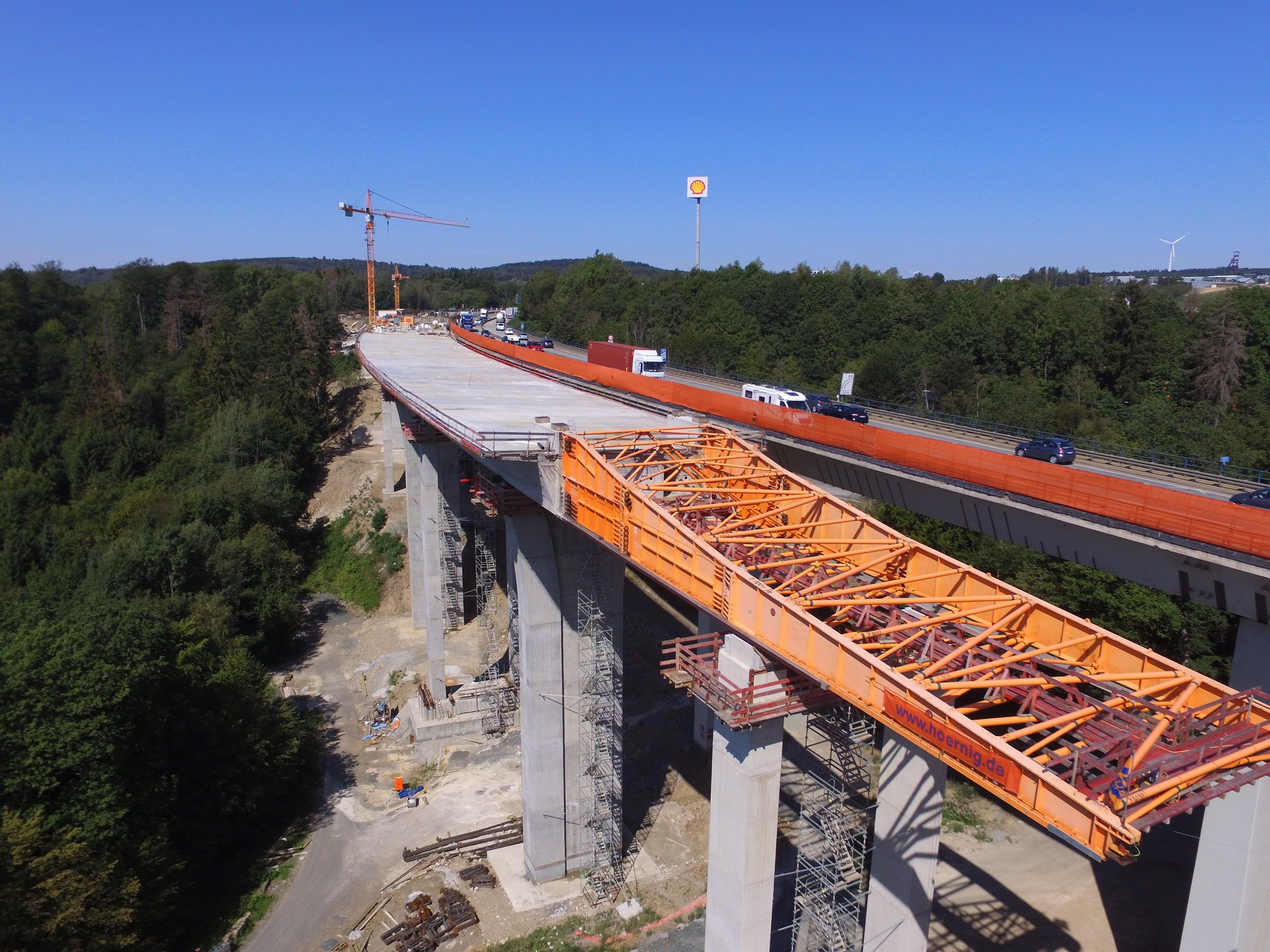
The existing superstructures of the Kalteiche Viaduct, which have already been reinforced several times, will be dismantled against their respective direction of manufacture using a launching girder (VSG). In this process, the field to be demolished is separated from the rest of the superstructure in the area of the coupling joint. In two deconstruction sections, there is no coupling joint with corresponding tendon anchorages, so that the longitudinal tendons (bundled tendons made of smooth wires) had to be anchored here by means of bond.
New Construction:
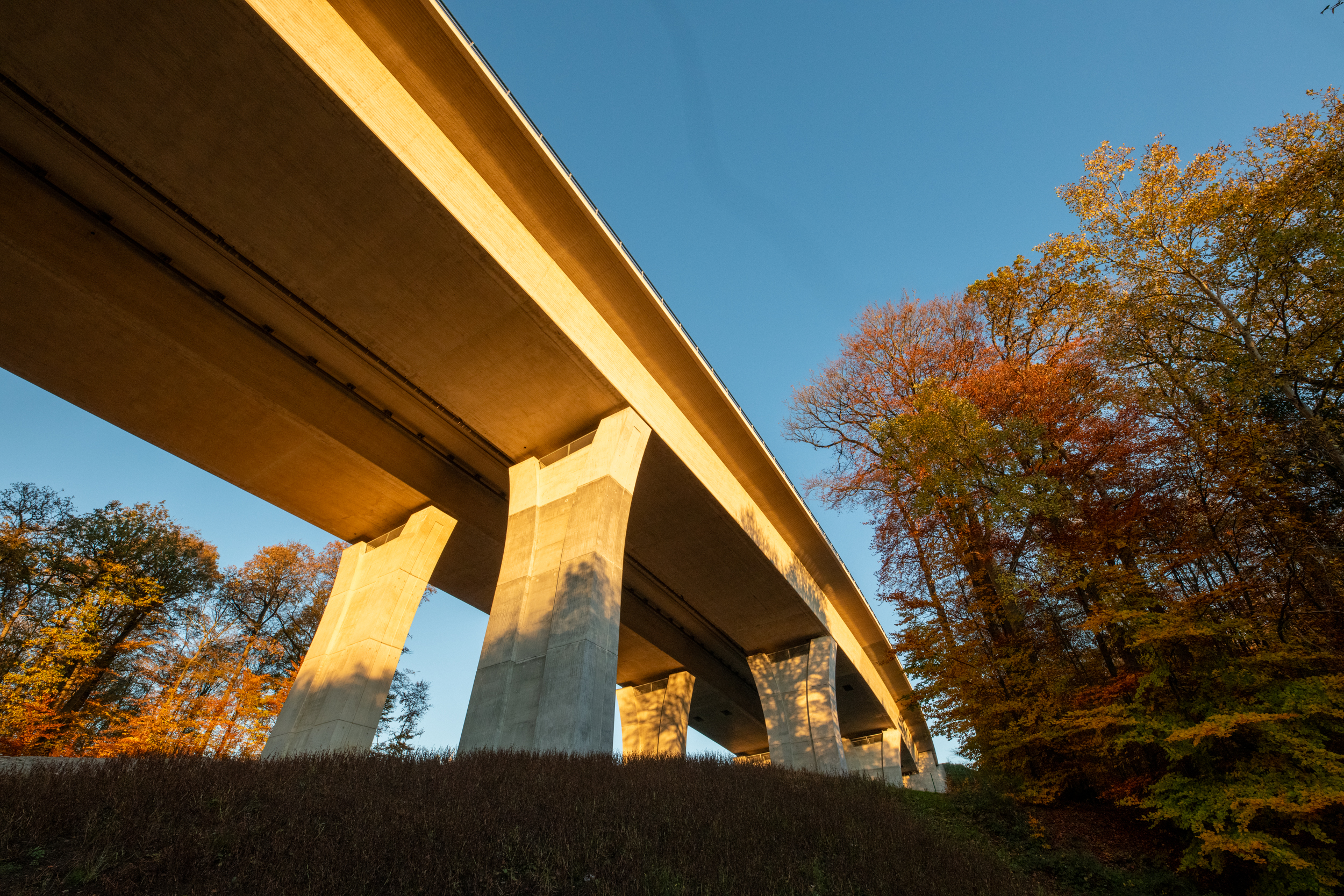
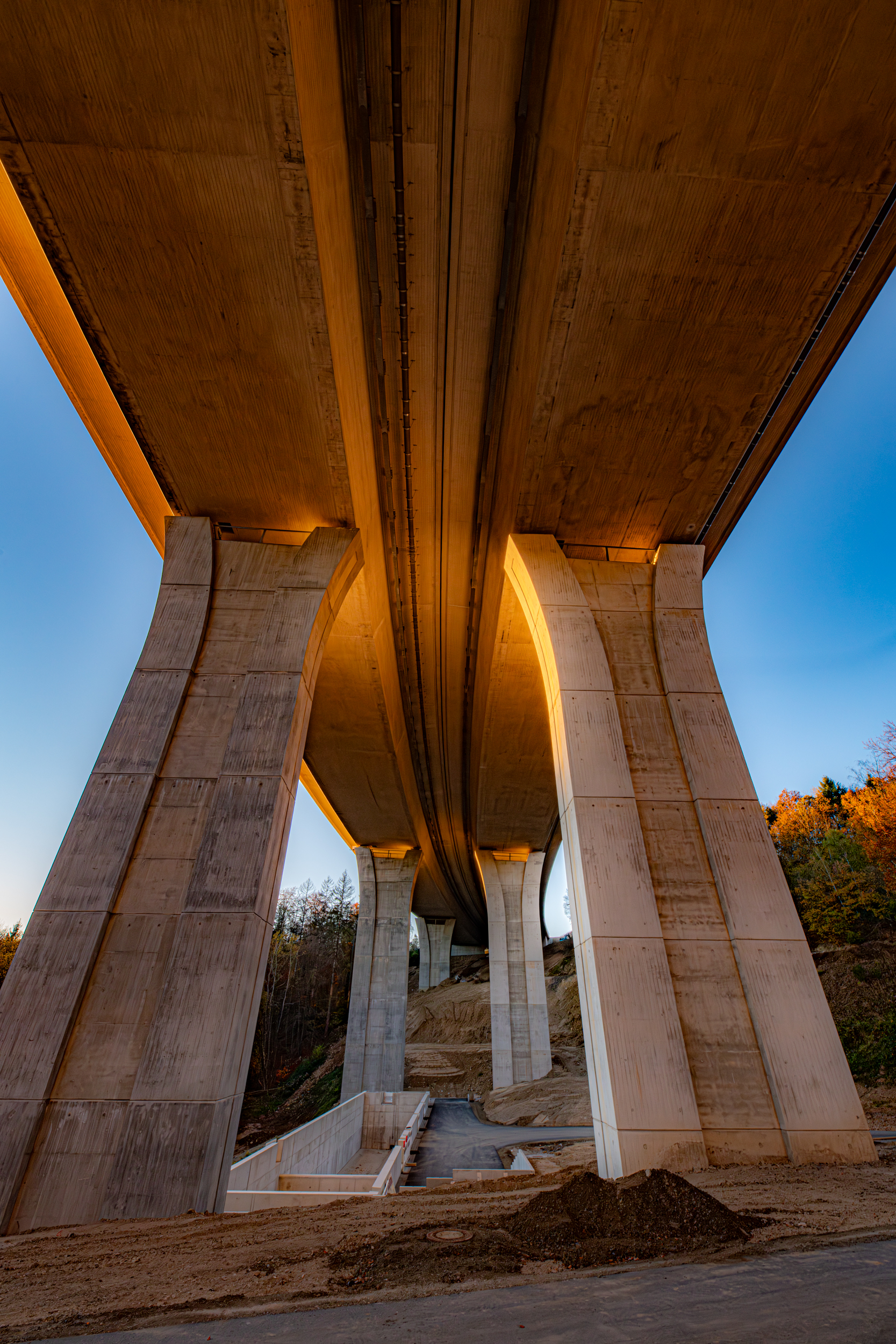
The standard cross-section of the new superstructure corresponds to a two-cell (three-web) hollow box cross-section. This is manufactured using the incremental launching method, with the bearings located only under the outer webs. Massive cross beams are arranged in the pier axes for the final condition. The verifications of the load-bearing capacity and serviceability in the construction state are critical when there is a non-stiffened cross-section in the area of the pier axes. This results in strongly differing moment loads on the directly supported outer webs and the indirectly supported central web.
Four auxiliary piers are used for launching the superstructure. Two auxiliary piers are founded on well foundations of the existing piers. Two further auxiliary piers with pier heights of up to 32.20 m are shallowly founded and are transversely displaced for the production of the second superstructure.
Due to the high weight of the superstructure, force-controlled auxiliary supports are arranged shortly behind the incremental launching abutment to support the lifting-launching system, which are activated for all displacements.
In order to take into account the effects of the profile deformation of the two-cell hollow box cross-section, the verifications in the ultimate limit state of serviceability in the final state had to be performed on the folded plate.
Special features
- Construction of a prestressed concrete superstructure with a two-cell hollow box cross-section using the incremental launching method, with the support only under the outer webs
- Construction of auxiliary piers in four axes for the new construction
- Two auxiliary piers are founded on the foundations of dismantled existing piers
- Two further auxiliary piers are transversely displaced for the production of the second superstructure
- Consideration of the influence of profile deformation in the verifications of the superstructure in the longitudinal direction in the construction and final state