B+S
Recalculation of the existing structure
Location |
Client |
Service |
Category |
Completion |
Description
The Deggenau Danube Bridge consists of two substructures: the main bridge and the approach bridge.
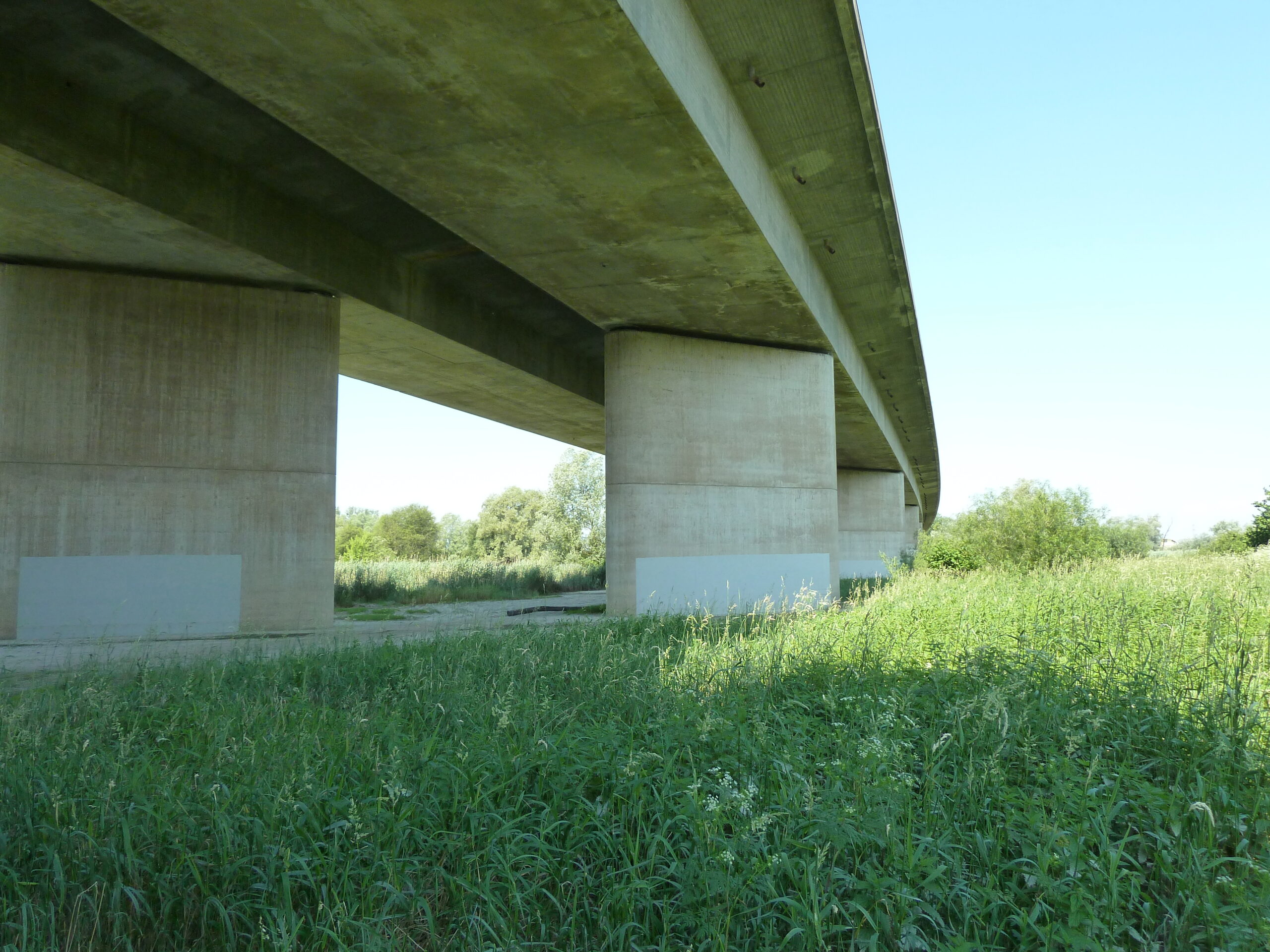
The approach bridge is designed as a seven-field beam made of prestressed concrete. Each directional lane is located on its own superstructure. The superstructures of the approach bridge are designed as two-cell hollow boxes and are prestressed to a limited extent in the longitudinal and transverse directions. The bearing axes are arranged at an angle of 45° to the longitudinal axis of the structure, which also made it necessary to model the superstructures of the approach bridge as a multi-bar model in order to be able to accurately record the structural behavior.Sigma Oval type prestressing steel was installed in the approach bridge, which is considered susceptible to stress corrosion cracking. Therefore, the verification of the announcement behavior was carried out for the longitudinal direction of the structure, the transverse direction of the structure, and for the supporting crossbeams.
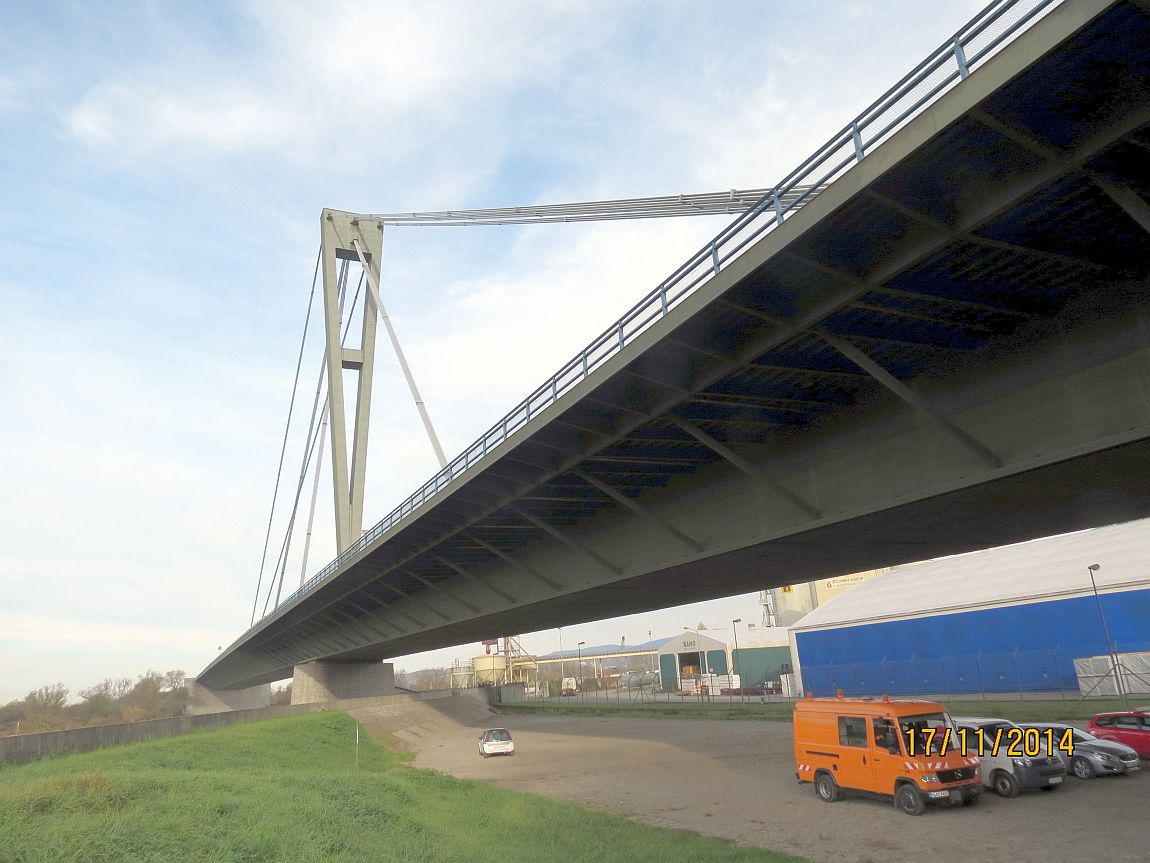
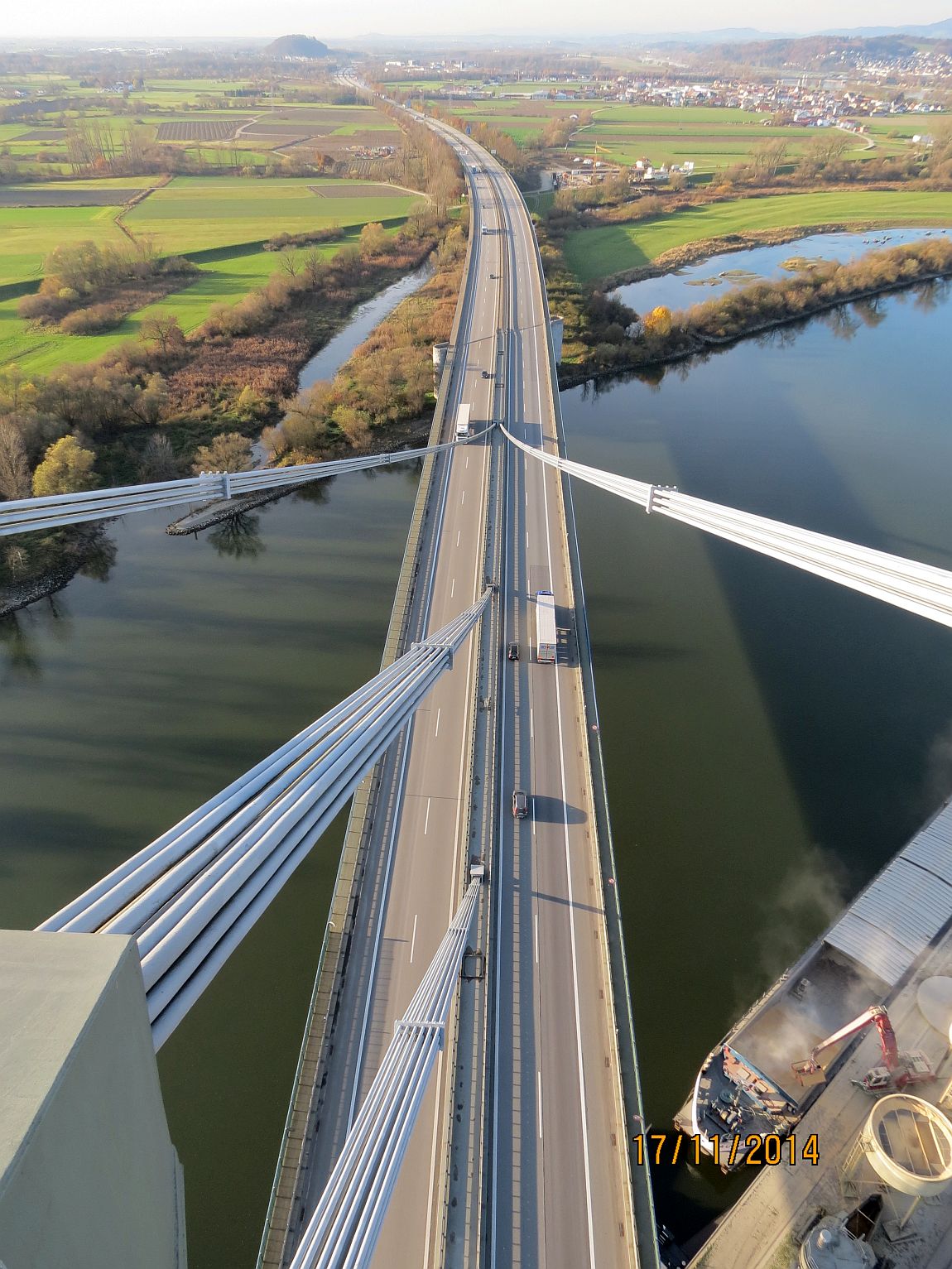
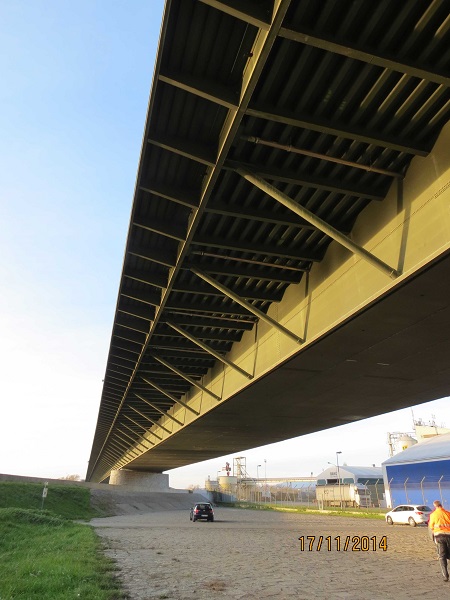
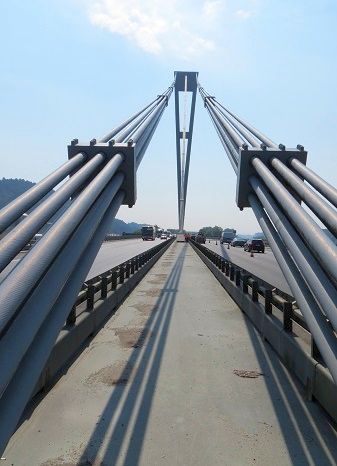
The main bridge has a length of 435.0 m. It is designed as a cable-stayed bridge with a two-cell steel hollow box cross-section with braced cantilevers. The river field has a span of 290.0 m. The roadway slab is designed as an orthotropic steel roadway slab. The superstructure is braced in the river opening at three points and in the foreland opening at two points by means of inclined cables via an approx. 82.0 m high pylon. In the front view, the pylon has a Y-shape, in which the individual stems are coupled in the central area and at the head by crossbeams. Fully locked cables were used for the inclined cables, which were combined to form corresponding cable packages. The cable packages are connected to the superstructure in the bridge axis. In order to take into account the different stress states of the individual webs, the superstructure of the main bridge was modeled with a multi-bar model, in which each web was represented by its own bar train. By modeling the cross frames and bulkheads, the transverse distribution of loads could be accurately recorded. In the course of the recalculation, Büchting + Streit AG recalculated the superstructures of both substructures in accordance with the recalculation guideline (recalculation stages 1 and 2). In the case of the approach bridge, the announcement behavior in the longitudinal and transverse directions of the structure as well as for the supporting crossbeams was additionally verified in accordance with the instructions for action on stress corrosion cracking.
Special features
Main bridge:
- Design as a cable-stayed bridge in steel construction
- 31.30 m wide cross-section (2-cell hollow box) with braced cantilevers and orthotropic roadway slab
- Skewed support on the pylon and the dividing pier
Approach bridge:
- 2-cell hollow box cross-section with extremely skewed support axes (45° to the longitudinal axis of the structure)
- Tendons made of Sigma prestressing steel, verification of the announcement behavior in the longitudinal and transverse directions of the structure as well as for the supporting crossbeams of the approach bridge
- Coupling joints with 100% abutment of the longitudinal tendons